Nuremberg vs Vienna: Cost, Crowds, and Vibe Compared
Quick answer
Choose Nuremberg if you want a compact, lower-friction historic city break with strong medieval and twentieth-century history and easy access to Franconia. Choose Vienna if you want a larger, grander trip built around major museums, imperial architecture, coffeehouse culture and a much deeper big-city itinerary. Neither is simply the cheaper or better version of the other.
Nuremberg and Vienna can appear in the same Central Europe shortlist for completely different reasons.
Both have historic centers, excellent public transport, German-speaking culture, Christmas-market appeal and enough history to fill several days.
But they do not deliver the same trip.
Vienna is a major European capital whose scale is part of the experience. Nuremberg is a much more compact city where the center becomes familiar quickly and where a longer stay naturally starts spilling into Franconia.
So the useful question is not “Which city is better?”
It is:
Which city matches the trip you actually want to take?
Nuremberg vs Vienna at a glance
| If you care most about… | Better fit |
|---|---|
| A compact 2–3 day city break | Nuremberg |
| Major art collections and museums | Vienna |
| Medieval atmosphere | Nuremberg |
| Imperial architecture and palaces | Vienna |
| Keeping daily logistics simple | Nuremberg |
| Filling 5–7 days without day trips | Vienna |
| Franconian day trips | Nuremberg |
| Classical music and coffeehouse culture | Vienna |
| A quieter-feeling historic base | Nuremberg |
| Big-city variety | Vienna |
If you already know which column excites you, you may have your answer.
1. Cost: Nuremberg has the easier low-budget shape — with a catch
For many ordinary travel dates, Nuremberg is easier to structure as a lower-cost trip.
The reason is not that everything is dramatically cheaper. It is that you can remove more spending categories without damaging the experience.
Stay centrally in Nuremberg and you can walk through much of the Old Town. You can spend long stretches sightseeing without admission fees. You do not need to build every day around large museums or palace complexes.
Vienna can absolutely be done on a budget, but its greatest strengths tempt you toward more paid experiences: major museums, imperial sites, performances and a broader city geography.
The Nuremberg exception: event dates
Never assume Nuremberg will automatically be cheaper.
Its accommodation market can tighten sharply around major trade fairs, events and the Christmas-market season. Nuremberg recorded more than 3.86 million overnight stays in 2025, with December reaching the strongest individual month since records began, helped by the Christkindlesmarkt.
That means the correct comparison is not:
average Nuremberg hotel vs average Vienna hotel
It is:
your Nuremberg hotel on your dates vs your Vienna hotel on your dates.
Check that before making the destination decision.
2. Crowds: size changes how crowding feels
Vienna receives huge numbers of visitors, but it is also a large city with many districts and an enormous amount of sightseeing capacity.
You can leave the most famous central streets and still have entire neighborhoods, museums, parks and food experiences to choose from.
Nuremberg’s visitor experience is geographically tighter.
That is normally an advantage: less transit, easier orientation, simpler days.
But when demand concentrates in the historic center — particularly during major events or Christmas-market periods — you notice it quickly because so much of the classic first visit happens in a relatively small area.
Choose Nuremberg for fewer crowds if…
You are traveling outside peak event periods and want a smaller historic center that can be explored early, late or slowly.
Choose Vienna for crowd escape if…
You are happy to leave the headline sights and use the city’s scale to your advantage.
Vienna can be busy without your entire day feeling busy.
3. Vibe: this is the real decision
The cities feel fundamentally different.
Nuremberg feels…
compact, historic, Franconian, grounded and easy to grasp.
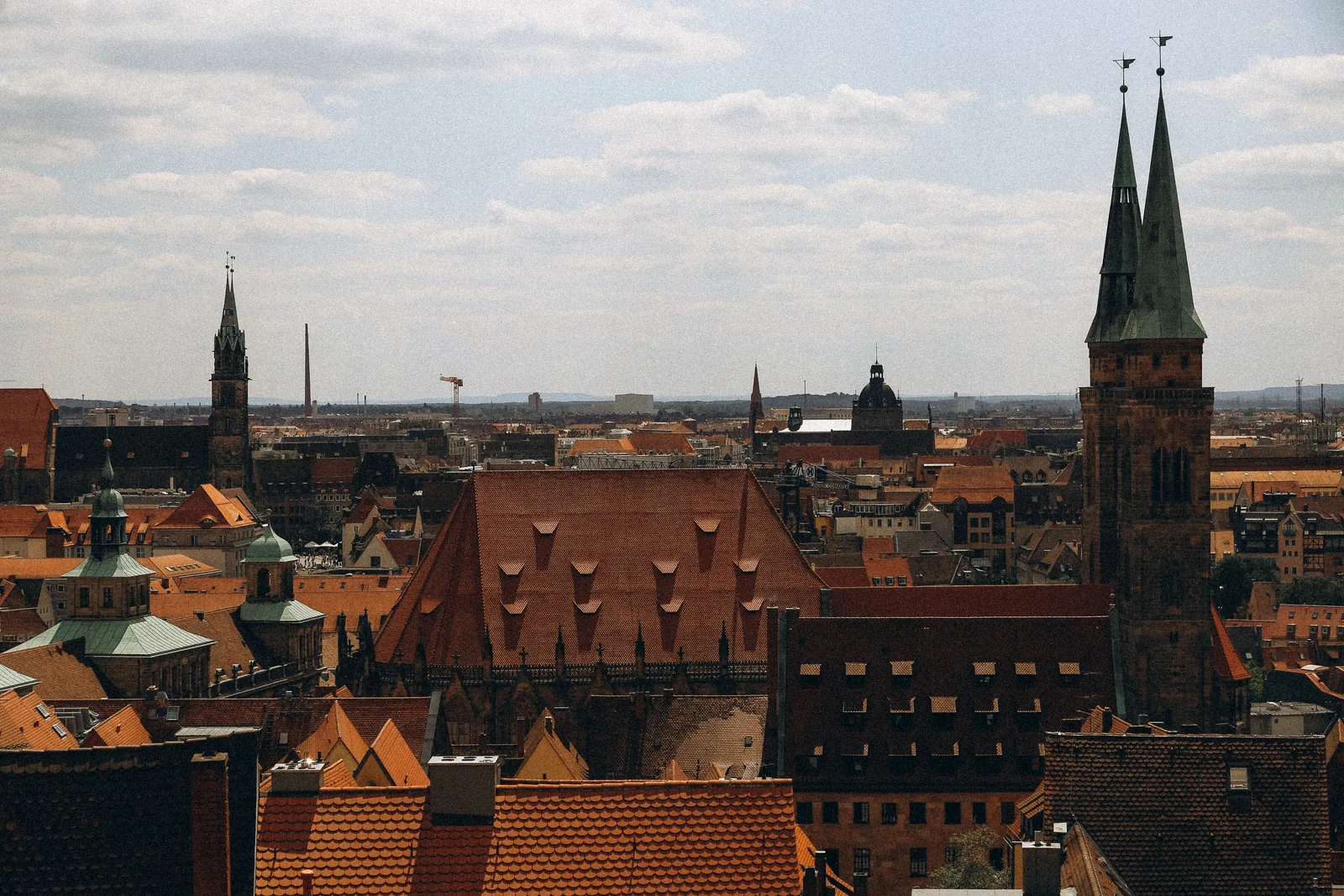
The city walls and castle give the center a strong visual identity. Its history is not limited to one period: medieval and imperial Nuremberg coexist with sites that force visitors to engage seriously with the twentieth century.
After a couple of days, you begin recognizing streets rather than repeatedly navigating them.
Vienna feels…
grand, layered, metropolitan, cultured and deliberately elegant in places.
Imperial architecture, monumental boulevards, art collections, concert culture, coffeehouses and distinct neighborhoods make the trip feel much larger.
You do not “finish” Vienna in the same way.
If Nuremberg feels like a historic city you can temporarily make your own, Vienna feels like a capital you keep uncovering.
4. History: choose the period you most want to understand
This is one of the clearest ways to decide.
Pick Nuremberg if your interests lean toward:
- the Holy Roman Empire;
- medieval urban history;
- the Imperial Castle;
- National Socialism and the Nazi Party Rally Grounds;
- the Nuremberg Trials;
- the relationship between a historic city and its twentieth-century destruction and reconstruction.
Pick Vienna if your interests lean toward:
- the Habsburg monarchy;
- imperial court life;
- European art history;
- classical music;
- fin-de-siècle culture;
- architecture and urban history across a much larger capital.
Neither city has “more history.”
They answer different historical questions.
5. Museums: Vienna wins on sheer depth
If museums are the reason you travel, Vienna is the stronger choice for most people.
You can build days around art, imperial collections, design, music and specialist museums without exhausting the options.
Nuremberg has substantial museums and historical sites, but the overall trip does not depend on museum-going to the same degree.
That makes Nuremberg particularly useful for travelers who like one meaningful museum or historical visit mixed with walking and outdoor city exploration.
For a rainy five-day trip, I would rather be in Vienna.
For a crisp two-day trip where I want to spend half my time outside, Nuremberg becomes very competitive.
6. Food: Franconian specificity vs capital-city range
Nuremberg gives you a strong regional identity quickly.
Nuremberg sausages, Franconian dishes and beer culture make it easy to connect food with place even on a short visit.
Vienna has its own deeply recognizable food traditions — coffeehouses, cakes, schnitzel and Viennese dishes — but also the range expected from a much larger international capital.
Choose Nuremberg if you want regional character without needing a food itinerary.
Choose Vienna if food and cafe culture are themselves major itinerary categories.
7. Transport: both are easy, but Nuremberg lets you ignore transport more often
Both cities have strong public transport.
The difference is how much you need it.
In central Nuremberg, a traveler with reasonably good mobility may spend large parts of a sightseeing day simply walking.
Vienna’s network is excellent, but the city is much larger. Using U-Bahn, tram and bus is part of experiencing it efficiently rather than a sign that you chose the wrong hotel.
Airport arrival
Nuremberg Airport connects directly to the city by U-Bahn, which makes arrival unusually straightforward.
Vienna also has strong airport-city connections, with several rail and bus options.
Neither city requires a rental car for an ordinary city break.
8. How many days do you need?
This may decide the comparison immediately.
Nuremberg
2 days: strong first visit.
3 days: more comfortable, with room for deeper history or museums.
4+ days: increasingly attractive if you add Franconian excursions.
7–14 days: works best as a regional base rather than 100% Nuremberg sightseeing.
Vienna
2 days: possible, but highly selective.
3–4 days: a solid first trip.
5–7 days: easy to justify if you enjoy museums, neighborhoods, food and culture.
A week in Vienna can remain a Vienna trip.
A week in Nuremberg naturally becomes a Nuremberg and Franconia trip.
That is not a weakness. It is a different travel model.
9. Which is better for a first Central Europe trip?
Vienna is the more obvious standalone headline destination.
If you are crossing the Atlantic or traveling a long distance for one major city and want the widest possible range of famous sights, museums and cultural experiences, Vienna is difficult to beat.
Nuremberg makes more sense when it fits into a broader Germany itinerary, when you prefer smaller cities, or when you actively dislike spending half a city break navigating a huge capital.
I would choose Vienna for a first trip if…
- this may be your only Central European city for years;
- art museums are a priority;
- you want palaces and imperial grandeur;
- classical music matters to you;
- you enjoy big-city neighborhoods;
- you have at least three or four full days.
I would choose Nuremberg if…
- you want Germany rather than Austria;
- medieval streets and city walls appeal more than palaces;
- twentieth-century history is a major interest;
- you prefer compact cities;
- you have only two or three days;
- you want to use one base to explore Franconia.
10. Which is better at Christmas?
This is not an automatic Nuremberg win despite the fame of the Christkindlesmarkt.
Nuremberg gives you one of Europe’s iconic Christmas-market experiences, but that fame creates exactly the accommodation and crowd pressure you would expect.
Vienna spreads the season across multiple markets and a much larger city, while adding imperial architecture, cafes, museums and indoor alternatives.
Choose Nuremberg if the Christkindlesmarkt itself is the point of the trip.
Choose Vienna if you want a broader winter city break that includes Christmas markets.
And in either case: price accommodation before becoming emotionally attached to the destination.
The decision matrix
Give each statement one point.
Nuremberg
- I prefer smaller cities.
- I have 2–3 days.
- I want medieval atmosphere.
- German twentieth-century history is important to me.
- I want to walk most of the time.
- I want easy Franconian day trips.
- Huge museums are not a priority.
Vienna
- I want a major European capital.
- I have 4–7 days.
- I love art museums.
- Imperial history fascinates me.
- Coffeehouses and classical music are part of the dream.
- I enjoy exploring different neighborhoods.
- I want enough indoor attractions to ignore bad weather.
If the score is close, your dates and accommodation prices should break the tie.
The simplest answer
Nuremberg is easier to consume slowly. Vienna rewards ambition.
Choose Nuremberg when you want a compact city whose history, streets and regional connections can anchor a relaxed trip.
Choose Vienna when you want the scale, collections and cultural depth of a capital and are happy to spend more time moving between experiences.
And if your itinerary allows both, do not treat one as a substitute for the other.
They are different enough that the contrast is precisely what makes pairing them interesting.
Related downloadable
The matching printable for this guide is in progress — browse the Checklists & Printables library for other ready-to-use downloads.
Browse Checklists & Printables