3 Days in Vienna: How to Split Your Time
What this guide solves
For three days in Vienna, use Day 1 for the historic center and Hofburg, Day 2 for Schönbrunn plus one complementary neighborhood or museum, and Day 3 for the Belvedere/museum side of the city or whichever major interest you deliberately left out. The key is to group sights geographically and limit each day to one major indoor anchor.
Three days in Vienna is enough for a very good first trip.
It is not enough to see everything — and that is exactly why the way you split your time matters.
Vienna punishes itineraries built from a list of famous names. Schönbrunn, the Hofburg, Belvedere, St. Stephen’s Cathedral, major museums and coffee houses all sound close when written in bullets. In practice, they pull you into different parts of the city, take very different amounts of time, and create museum fatigue surprisingly quickly.
The solution is not to move faster.
It is to make each day geographically coherent and emotionally different.
The simple three-day structure
| Day | Main focus | Best for |
|---|---|---|
| Day 1 | Historic center + Hofburg | Orientation, architecture, imperial context |
| Day 2 | Schönbrunn + west/southwest Vienna | Palace day, gardens, slower pace |
| Day 3 | Belvedere / museums / personal priority | Art, culture, whatever matters most to you |
This structure gives you one major anchor each day and leaves enough space around it for Vienna to feel like a city rather than a museum queue.
Day 1 — Historic Vienna first
Start where Vienna makes the most immediate sense: the center.
A useful walking flow is:
Stephansplatz → Graben → Kohlmarkt → Hofburg area → Ringstrasse edge → coffee or dinner nearby
You do not need to follow that exact order, but keeping the first day inside the historic core helps you understand the city before you start using transit heavily.
Morning: St. Stephen’s Cathedral and the old center
Begin at Stephansplatz early enough that the square still feels navigable.
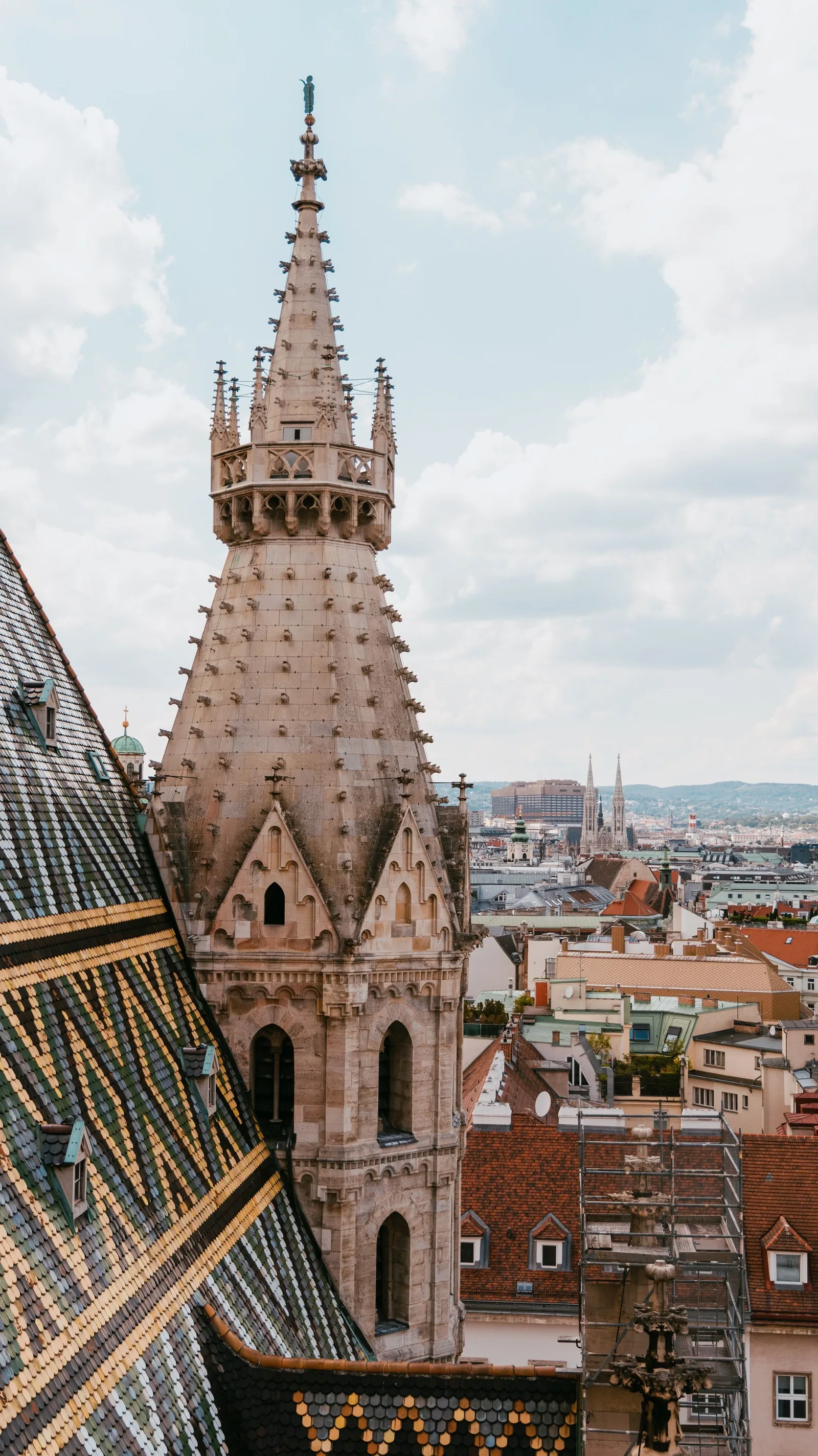
St. Stephen’s Cathedral works well as a first landmark because it gives you an obvious visual center. From there, the streets around Graben and Kohlmarkt naturally pull you toward the Hofburg.
Do not turn this into a speed-walk.
Vienna’s center rewards noticing facades, courtyards, shopfronts and side streets. If you arrive with a rigid schedule, you will spend the first morning checking your phone instead of looking at the city.
Midday: choose one Hofburg experience
The Hofburg complex is enormous in both physical and historical terms.
Do not assume “visit the Hofburg” means entering every associated museum or attraction.
Choose the part that matches your interests:
- imperial apartments and court life;
- the Imperial Treasury;
- the Spanish Riding School;
- architecture and courtyards without a long indoor visit.
One substantial Hofburg experience is enough for most three-day itineraries.
Afternoon: Ringstrasse without trying to conquer it
After the Hofburg, move toward the Ringstrasse and choose a direction rather than circling the entire boulevard.
Depending on your interests, you might pass the Parliament, Rathaus, Burgtheater, State Opera or museum quarter area.
The point is orientation.
You will revisit parts of this zone over the next two days.
Evening: let Vienna be Vienna
Your first evening should not require another major ticket.
A coffee house, dinner, a walk through the illuminated center or a pre-booked performance all work better than cramming in another museum.
If a concert or opera is one of the reasons you came to Vienna, Day 1 or Day 3 evening is a natural place for it.
Day 2 — Schönbrunn without making it a half-day sprint
Schönbrunn is the attraction most likely to break a three-day Vienna itinerary because travelers underestimate how much time the palace and grounds can absorb.
Treat it as the day’s main event.
Morning: go directly to Schönbrunn
Reserve the morning for the palace and whichever part of the complex matters most to you.
The exact amount of time depends on whether you tour interiors, walk the gardens, climb toward the Gloriette, visit additional attractions or simply want the main palace experience.
The mistake is scheduling something equally ambitious immediately afterward.
Lunch: stay flexible
After a large palace visit, you may want a proper lunch and a pause rather than another attraction.
That is not wasted itinerary time.
It is what prevents Day 2 from feeling like a school excursion.
Afternoon option A: return toward the center slowly
If you are tired, make the afternoon light.
Return toward central Vienna, explore a neighborhood, stop for coffee, shop, or walk somewhere you passed too quickly on Day 1.
This is the option I would choose for many first-time visitors.
Afternoon option B: add one compatible interest
If you still have energy, choose one attraction that fits geographically or thematically.
Good additions are places that do not require another three-hour commitment.
Avoid the classic mistake of leaving Schönbrunn and immediately attempting a major art museum simply because it is still open.
You will remember both less.
Day 3 — Build the day around your strongest remaining interest
By Day 3, the itinerary should stop pretending every traveler wants the same Vienna.
Choose one of these frameworks.
Option 1: Art-focused Vienna
Make Belvedere or one of Vienna’s major art museums your anchor.
Then build the rest of the day around it rather than adding several large collections.
A strong art day might be:
Belvedere → lunch → one smaller cultural stop → relaxed central evening
or
Kunsthistorisches Museum → museum quarter / nearby streets → dinner
Two huge museums in one day are possible.
That does not make them a good idea.
Option 2: Imperial Vienna, part two
If Day 1 made you want more Habsburg history, use Day 3 for the imperial sites you deliberately skipped.
This is better than trying to fit them all into the first afternoon.
Your trip now has a coherent theme rather than a random accumulation of admissions.
Option 3: Neighborhood Vienna
If you already feel saturated with palaces and museums, spend Day 3 seeing how Vienna works beyond the headline monuments.
Explore a market, residential streets, independent shops, parks, cafes or neighborhoods that give the city a different texture.
A trip can be culturally rich without entering another institution.
Option 4: Music-first Vienna
If classical music is central to your trip, structure the day around the performance rather than treating the concert as something squeezed into the evening.
Have a slower afternoon, eat early enough to avoid rushing, and arrive without having walked 25,000 steps first.
The experience you care about most deserves your best energy.
Where the famous sights fit
Here is the easiest way to place the major first-time attractions without duplicating geography.
| Sight / experience | Best day |
|---|---|
| St. Stephen’s Cathedral | Day 1 |
| Hofburg | Day 1 |
| Historic center | Day 1 |
| Ringstrasse orientation | Day 1 |
| Schönbrunn | Day 2 |
| Belvedere | Day 3 |
| Kunsthistorisches Museum | Day 1 or 3 |
| Coffee-house experience | Any day; do not over-schedule it |
| Concert / opera | Day 1 or 3 evening |
| Naschmarkt / neighborhood wandering | Day 2 or 3 |
This is not a command. It is a geography-saving template.
The one-major-indoor-attraction rule
For a three-day trip, I recommend one major indoor anchor per day.
Examples:
- Day 1: Hofburg interiors;
- Day 2: Schönbrunn palace;
- Day 3: Belvedere or a major museum.
Everything else can be shorter, outdoor, optional or spontaneous.
This protects you from the strange exhaustion that comes from spending six hours looking at important things under artificial light.
What to skip on a three-day first visit
You do not need to skip the same things as everyone else.
Skip whatever scores lowest on your interest list.
But these are useful warning signs:
Skip an attraction if you only added it because it appears on every list
Famous is not the same as personally worthwhile.
Skip a second major palace if the first one was enough
You are not collecting imperial residences.
Skip a museum if you are already tired before entering
The ticket price does not restore your attention span.
Skip a cross-city detour for one photograph
Three days is short enough that transport friction matters.
How much should you pre-book?
Pre-book the experiences where timing genuinely matters to you.
That can include:
- a specific Schönbrunn visit;
- a performance;
- a timed museum entry if required or strongly preferred;
- a special tour;
- a restaurant that is part of the trip rather than merely somewhere to eat.
Do not pre-book every hour.
Vienna has too many good alternatives for that to be necessary, and weather or energy can change what feels appealing.
What if it rains?
Vienna is one of the easier cities to reorganize in bad weather because indoor options are abundant.
Use the weather forecast to swap days, not to rebuild the whole itinerary.
If Day 2 is pouring rain and Day 3 is clear, you might move an art museum forward and save palace gardens or long walks for the better day.
Your itinerary should be modular enough to survive that change.
What if you have only 2.5 days?
Compress by removing an entire category, not by shortening everything.
For example:
- Day 1: center + Hofburg;
- Day 2: Schönbrunn;
- half Day 3: Belvedere or major museum.
That is better than doing 70% of six attractions.
What if you have a fourth day?
A fourth day changes Vienna significantly.
Now you can add:
- another major museum;
- deeper neighborhood exploration;
- a slower market/food day;
- a specialist interest;
- a day trip if Vienna itself no longer fills your wish list.
Most importantly, you no longer need every day to justify its existence.
The best three-day Vienna itinerary is not the fullest one
If your schedule contains a palace, cathedral, three museums, a market, a concert, two famous cafes and a day trip, you do not have a Vienna itinerary.
You have a logistics problem.
Three days works best when you choose three anchors, one for each day, and let the city fill the spaces between them.
For most first-time visitors, that means:
Day 1: center + Hofburg
Day 2: Schönbrunn
Day 3: art / culture / your strongest remaining interest
That is enough structure to prevent wasted time and enough freedom to make the trip feel like yours.
Related downloadable
The matching printable for this guide is in progress — browse the Checklists & Printables library for other ready-to-use downloads.
Browse Checklists & Printables