Salzburg vs Vermont: Which Fits Your Trip Better?
What this guide solves
Salzburg and Vermont can look surprisingly similar on a mood board.
Mountains. Lakes. Villages. Forests turning gold. Crisp mornings. Scenic roads. Places where a slow breakfast and a long walk can feel like the main event.
But they are not interchangeable trips.
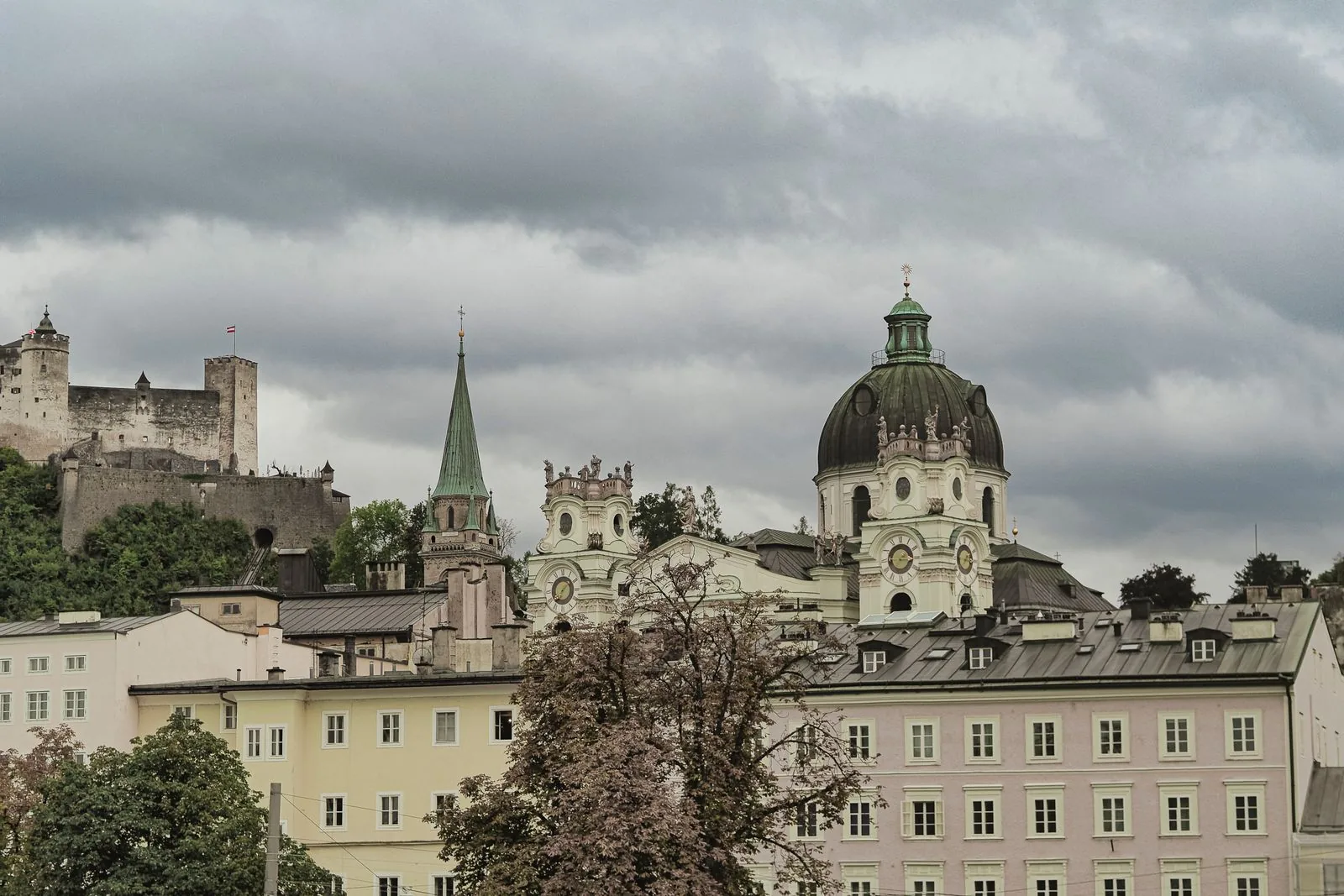
Salzburg works unusually well when you want a compact historic city, alpine scenery and day trips without building the entire holiday around a car. Vermont is stronger when the road itself is part of the experience: small towns, farm stands, back roads, changing foliage and the freedom to stop because a view looks good.
So don’t choose between them by asking which is prettier.
Ask how you want the trip to work.
Quick answer
Choose Salzburg if you want:
- a beautiful city as your base;
- mountain scenery without needing to drive every day;
- museums, cafés and historic streets as a weather-proof backup;
- easy access to several different day-trip styles;
- a trip that combines culture and nature in roughly equal measure.
Choose Vermont if you want:
- a road trip rather than a city break;
- fall foliage to be the central event;
- small towns, back roads, farms and countryside;
- flexibility to follow the best conditions from one region to another;
- a trip where driving is part of the pleasure rather than dead time between sights.
If your mental picture is Mozart + mountains + lakes, Salzburg is the clearer fit.
If it is maple trees + winding roads + New England towns, choose Vermont.
Salzburg vs Vermont at a glance
| Question | Salzburg | Vermont |
|---|---|---|
| Best trip shape | One base + day trips | Multi-stop road trip |
| Car necessary? | Usually no | Often very useful |
| Strongest visual identity | Alps + baroque city | Forests + rural New England |
| Autumn color | Beautiful, but not the whole reason to go | One of the main reasons to go |
| Bad-weather backup | Excellent | More limited outside larger towns |
| Cultural depth | Very high | More local/rural than monumental |
| Spontaneous scenic driving | Secondary | A major part of the experience |
| Easy first international trip | Yes | Easier for travelers already comfortable driving in the U.S. |
| Best for | Culture + nature | Foliage + road-trip atmosphere |
That table is the short version. The differences become much more important once you start planning actual days.
The biggest difference: Salzburg has a center; Vermont is the journey
This is the distinction I would use to make the decision.
In Salzburg, you can unpack once and immediately have a functioning trip. The historic center, museums, restaurants and city viewpoints are close together, while mountains and regional excursions can be layered around them.
That creates a useful rhythm:
city day → mountain day → city afternoon → lake day → flexible weather day.
Vermont is less about returning to one obvious center every evening.
Its tourism appeal is spread across regions, towns, valleys, mountain roads and scenic routes. Vermont Tourism explicitly presents scenic drives and back roads as one of the state’s core ways to explore, with historic downtowns, farmland, covered bridges and mountain passes forming part of the journey rather than simply the route between attractions.
That means the ideal Vermont itinerary is often:
drive → stop → walk → town → farm or café → scenic road → next base.
Neither is better. But confusing the two travel styles can produce the wrong holiday.
If autumn color is the priority, Vermont wins
Salzburg is lovely in autumn. The city tourism office highlights cooler-weather walks, city mountains, museums and seasonal atmosphere as reasons to visit in fall.
But if your actual dream is a trip built around fall foliage, Vermont is the more specialized choice.
Vermont Tourism says roughly 70% of the state is forested and describes peak color as generally building from higher elevations and northern areas toward valleys and southern Vermont as the season progresses. Exact timing changes from year to year because temperature, rainfall, elevation and local conditions matter.
That variability is not a flaw in the trip. It should shape the trip.
Instead of booking one famous town and assuming the leaves will cooperate, treat Vermont as a moving landscape. Build enough geographic flexibility to drive toward better color if one area is early or late.
The useful foliage rule
Don’t plan Vermont around a single supposed “peak foliage date.”
Plan around:
- a broad seasonal window;
- two or three possible regions;
- a car or transport plan that lets you move;
- the current foliage report shortly before and during the trip.
That is far more robust than trying to predict nature months in advance.
If you don’t want to drive, Salzburg wins easily
This is probably the clearest practical separator.
You can build a very satisfying Salzburg trip around walking and public transport, then choose specific excursions that fit the network or use an organized tour only when it genuinely makes the day easier.
Vermont does have buses, trains, walkable downtowns and other transport options. But the tourism board itself emphasizes scenic driving as an important way to move around and sightsee at the same time.
For a foliage-focused itinerary, a car gives you something particularly valuable: the ability to change your mind.
A road looks beautiful? Turn onto it.
The color is better farther south? Change tomorrow’s plan.
Rain ruins a hike? Drive through villages instead.
That flexibility is much harder to reproduce with a rigid public-transport itinerary.
So if one traveler says, “I absolutely do not want to rent a car,” I would move Salzburg significantly higher on the list.
Which feels more spectacular?
They are spectacular in different ways.
Salzburg: vertical drama
The Alps give Salzburg’s wider region a sense of scale. Peaks rise sharply, lakes sit below mountain walls and cable cars can change your perspective very quickly.
The contrast is part of the appeal: ornate historic streets in the morning, then alpine scenery later the same day.
Vermont: immersive landscape
Vermont’s drama is often less about one giant landmark and more about being surrounded by the season.
A winding road, red and orange hillsides, a white church, a farm field and a small town can combine into the scene you came for. Vermont Tourism notes that scenic routes range from major roads to mountain gaps and back roads, with foliage changing across elevation and geography.
If you want big alpine scale, Salzburg.
If you want to feel as though you are inside autumn, Vermont.
Which is better for a 4–5 day trip?
Salzburg.
Not because Vermont cannot fill five days, but because Salzburg compresses variety more efficiently.
In a short trip you can realistically combine:
- Salzburg Old Town;
- a city viewpoint;
- museums or historic interiors;
- one major alpine outing;
- one lake or village day;
- excellent evening options without changing hotels constantly.
With Vermont, I would rather have enough time to let the route breathe. Racing through several photogenic towns just to say you saw them misses much of the point.
For a short Vermont trip, choose one region rather than trying to “do Vermont.”
Which is better for 7–10 days?
This is much closer.
Seven to ten days makes Salzburg more expansive: you can combine the city with multiple nature days and perhaps a secondary base.
But that same amount of time makes Vermont significantly better because you can finally travel slowly enough to enjoy it.
A strong Vermont week might include:
- two nights around one northern or central base;
- scenic drives rather than direct transfers;
- a hike or rail trail;
- a small-town afternoon with no major attraction attached;
- a second region chosen partly according to foliage conditions;
- one deliberately unplanned day.
For ten days, I would choose based almost entirely on desired travel style rather than trip length.
What happens when the weather turns bad?
Salzburg has the stronger fallback plan.
Rain does not eliminate the destination. You still have historic interiors, museums, cafés, churches, music-related sights and a city that rewards wandering between showers.
Vermont can still be enjoyable in poor weather — food, towns, breweries, shops and covered landscapes do not disappear — but a trip heavily designed around hiking, foliage viewpoints and scenic roads is more exposed to weather.
There is another autumn-specific issue: wind and heavy rain can affect leaf retention. Vermont Tourism specifically notes that weather and earlier drought conditions can influence both the timing and duration of foliage.
If you are highly risk-averse about weather, Salzburg offers more layers of backup activity.
Which is easier to plan?
Salzburg.
The structure is intuitive:
- choose accommodation in or near the city;
- reserve the fixed experiences you care about;
- shortlist several nature days;
- move the weather-dependent ones around.
Vermont asks for a different kind of planning. You need to think about route logic, not just attractions.
Where will you sleep after the scenic drive?
Does moving hotels improve the trip or just create luggage friction?
Which roads are enjoyable enough to count as an activity?
Can you switch regions if foliage timing is different from expectations?
The reward is freedom, but freedom still needs a sensible framework.
Which is better without a packed itinerary?
Vermont has an edge here.
One of the best Vermont days can be almost embarrassingly simple:
- drive a scenic road;
- stop in a town you had not planned to visit;
- buy something at a farm stand;
- walk for an hour;
- find a viewpoint;
- have dinner near wherever you ended up.
That is not “failing to sightsee.” It is the trip.
Salzburg can absolutely be slow, but there are more obvious named sights and excursions competing for your attention.
If you are happiest when a holiday has space rather than a checklist, Vermont may fit you better.
Which destination is better for photography?
Again: different strengths.
Choose Salzburg for:
- mountain-and-lake compositions;
- architecture framed by peaks;
- elevated city views;
- dramatic alpine weather;
- blue-hour city photography.
Choose Vermont for:
- foliage roads;
- rural landscapes;
- barns, churches and villages;
- layers of colored hills;
- atmospheric roadside scenes.
For autumn-specific photography, Vermont gives you more opportunities to make the season itself the subject.
The crowd question is more complicated than it looks
Both destinations can become busy when demand concentrates around a narrow experience.
In Salzburg, that concentration often happens at famous sights, popular excursions and central Old Town corridors.
In Vermont, fall creates a different problem: enormous interest in a landscape whose most famous towns and roads were not designed to function like theme parks.
The solution in both places is similar: don’t make every day out of the most famous photograph on the internet.
In Vermont, this matters particularly because foliage is widespread. The official tourism material repeatedly encourages scenic routes across multiple regions and even recommends lesser-known hikes and roads as alternatives to the busiest leaf-peeping locations.
You do not need the same three Instagram locations to experience Vermont in fall.
Who should choose Salzburg?
Choose Salzburg if most of these sound like you:
- “I want nature, but I also want a real city.”
- “I don’t want to rent a car unless I have to.”
- “I like having several good options when the weather changes.”
- “Historic architecture matters to me.”
- “I want mountains but not a hiking-only holiday.”
- “I like unpacking once.”
- “I want evenings with restaurants, culture and easy walking.”
Salzburg is particularly good for couples or first-time alpine travelers who want impressive nature without turning the entire trip into an outdoor expedition.
Who should choose Vermont?
Choose Vermont if these sound more like you:
- “The road trip is part of the holiday.”
- “I want autumn to be the main character.”
- “I love small towns more than major monuments.”
- “I don’t mind changing accommodation.”
- “I want to improvise according to weather and foliage.”
- “A beautiful drive counts as a great day.”
- “I’d rather find a quiet back road than tick off ten attractions.”
Vermont rewards travelers who enjoy looking around, not just arriving.
My decision rule
If you’re still stuck, use this:
Choose Salzburg for a destination-centered trip. Choose Vermont for a journey-centered trip.
Salzburg gives you a strong home base and lets you add mountains around it.
Vermont asks you to move through the landscape and let the route itself become the attraction.
That single difference affects almost everything else: whether you need a car, how often you change hotels, what bad weather does to the trip, how tightly you schedule your days and even what photographs you bring home.
If I were planning either trip
For Salzburg, I would book the accommodation first, choose one or two expensive/high-priority experiences, then keep at least two nature days interchangeable according to weather.
For Vermont in fall, I would choose a broad route and refundable accommodation where practical, then follow the official foliage reports closer to departure rather than trying to predict exact peak color far in advance.
That is the real difference between planning these destinations well.
One rewards a base with optional adventures.
The other rewards a framework with room to wander.
Continue planning
If Salzburg is winning, read Salzburg in 7 Days vs 10 Days and How Much to Budget for a Bucket-List Nature Trip in Salzburg.
If Vermont is winning, the next useful question is not “what are the top 20 things to see?” It is which region fits your dates and how much driving you actually want to do.
Related downloadable
The matching printable for this guide is in progress — browse the Checklists & Printables library for other ready-to-use downloads.
Browse Checklists & Printables