Nº 04
Madagascar's Avenue of the Baobabs
Morondava, Madagascar 20.25° S · 44.42° E
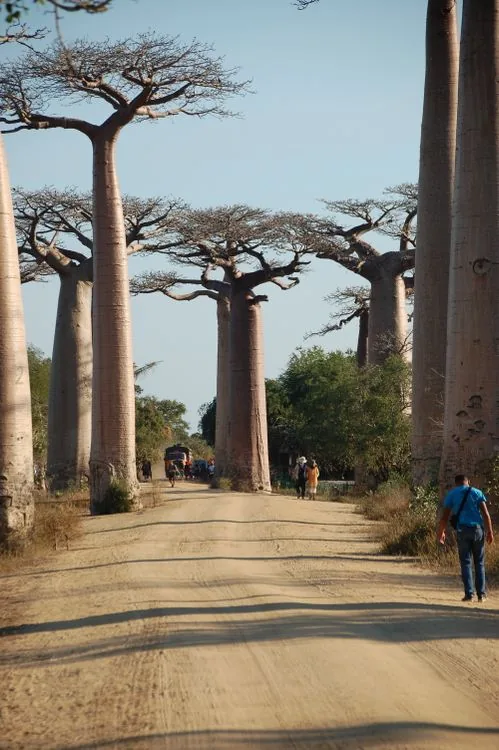
A red dirt road lined with giant baobabs, some of them centuries old, standing like columns against the sunset in western Madagascar.
“The sun dropping behind the baobabs, the sky turning orange, and a zebu cart creaking slowly down the road between the trunks.”
Some trees look old. These look ancient. Along a dusty road near Morondava, a line of giant baobabs rises straight out of the fields, their thick grey trunks bare for most of their height and their branches bunched at the top like roots reaching into the sky. They were once part of a dense forest; today they stand almost alone, which is exactly what makes them unforgettable.
It belongs on the list because at the right hour it stops looking like a real place. As the sun sets, the trunks turn to silhouettes and the sky goes from gold to red to purple. Children walk home along the road, a zebu cart passes between the trees, and the whole scene feels unchanged for centuries.
And it opens a door to one of the strangest countries on Earth. Madagascar has been isolated for so long that most of its wildlife exists nowhere else. The baobabs are the icon — but the lemurs, the dry forests and the stone labyrinths further north are why people leave already planning to come back.
From someday to a real plan
- Days needed
- 2–3 days in Morondava
- Best months
- May – Oct
- Budget
- US$80–250 per person per day
- Getting there
- Remote
- Crowds
- Moderate
One sunset and one sunrise at the avenue, plus Kirindy Forest. A first trip to Madagascar itself usually needs 12–16 days — the island is huge and roads are slow.
The dry season: dependable roads and clear skies for sunset. Jan–Mar is cyclone season on the west coast.
Simple hotels in Morondava are affordable; the big cost across Madagascar is a private car with driver, domestic flights and guides. Orientation ranges — verify before booking.
Fly from Antananarivo to Morondava (about 1 hour) or drive roughly 2 days on the road. The avenue is about 20 km from town by car.
Sunset is the one busy moment, with tour vehicles and photographers. Sunrise is often almost empty.
The year at a glance
- Jan
- Feb
- Mar
- Apr
- May
- Jun
- Jul
- Aug
- Sep
- Oct
- Nov
- Dec
Madagascar's west is hot and wet from roughly December to March, with cyclone risk and flooded tracks. Apr–Nov is dry. If you want to continue north to Tsingy de Bemaraha, stick to Jun–Oct, when that road is reliably open.
What you'll remember
- 01
Sunset on the avenue
The classic view: silhouettes of Grandidier's baobabs, some estimated to be several hundred years old and around 30 m tall.
- 02
Sunrise, almost alone
The same trees with soft light, no tour groups and village life starting along the road.
- 03
Baobab Amoureux
Two baobabs twisted around each other, a short drive from the avenue — a local symbol of love.
- 04
Kirindy Forest by night
A dry forest reserve north of Morondava where night walks look for tiny mouse lemurs, and daytime visits may find the fossa, Madagascar's largest predator.
- 05
A pirogue to a fishing village
Traditional outrigger canoes cross the mangroves near Morondava to small Vezo fishing villages.
How the trip fits together
- 1–2 nights
Antananarivo
The capital and main international airport. A buffer day helps with delayed connections.
- 2 days
Morondava
Beach town base for the avenue at sunset and sunrise.
- 1 night
Kirindy Forest
Night walks and lemurs on the way north.
- +3–4 days
Tsingy de Bemaraha (optional)
Continue by 4x4 to the limestone forest — one of the Hidden Wonders on this list.
Put it on your list if…
- You want one of the most photogenic landscapes in Africa.
- You're curious about wildlife found nowhere else — Madagascar's lemurs, chameleons and baobabs.
- You can travel slowly and accept long drives as part of the experience.
Maybe skip it if…
- You have less than 10 days for Madagascar — the avenue alone rarely justifies the journey.
- You need tightly reliable schedules: domestic flights and roads can change at short notice.
- You can only travel in Jan–Mar, the wet and cyclone season.
- Check Madagascar's visa and e-visa requirements on official government sources.
- Ask a travel health clinic about malaria prevention and recommended vaccinations.
- Hire a reputable driver and vehicle through a licensed agency; self-driving is not practical for most visitors.
- Leave buffer days around domestic flights — schedules can change with little notice.