Nº 10
Salar de Uyuni
Potosí, Bolivia 20.13° S · 67.49° W
The world's largest salt flat, high in the Bolivian Andes — a white hexagon-patterned desert in the dry season and a giant mirror of the sky after rain.
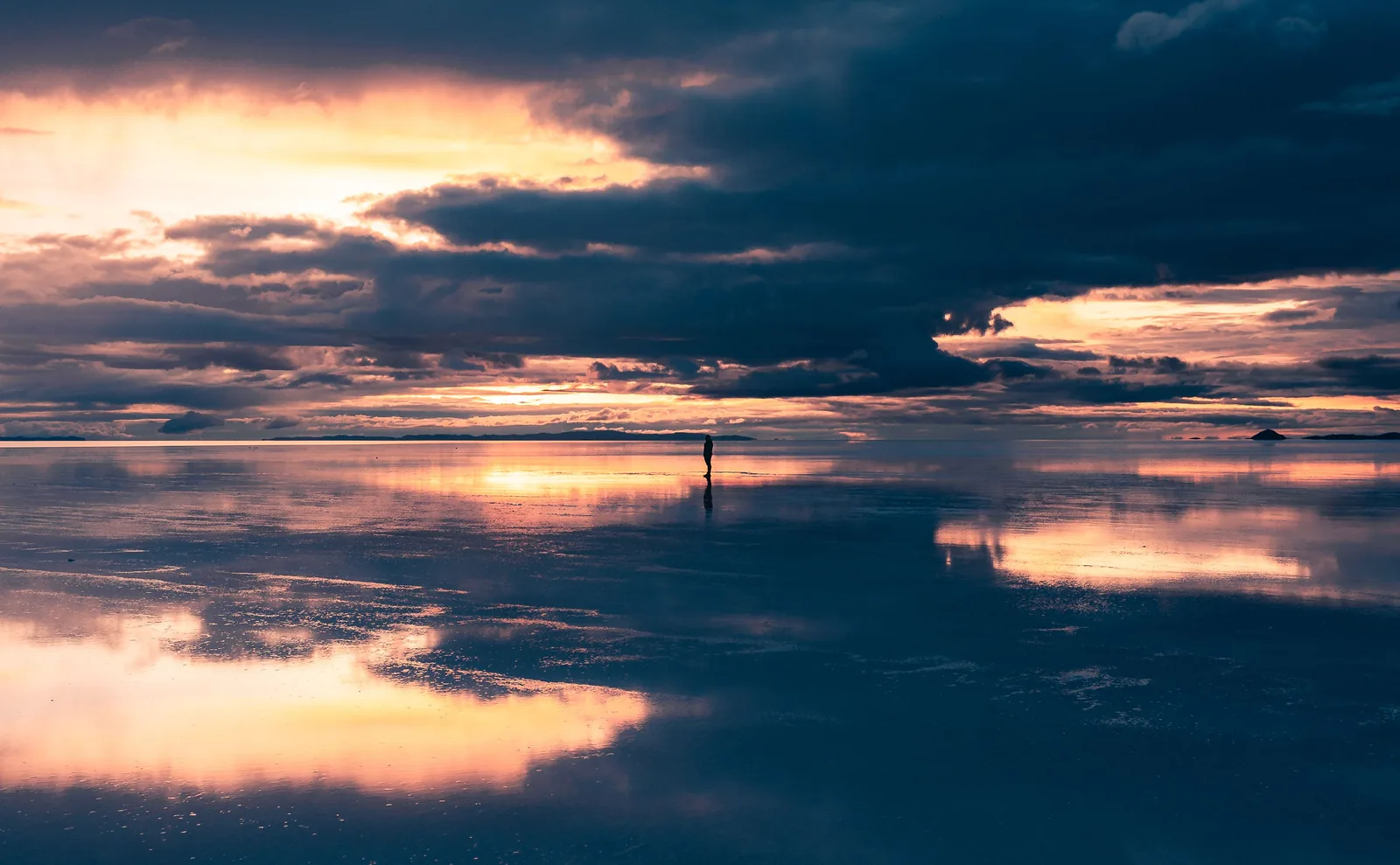
“Standing in a few centimetres of water in the middle of the salt flat at sunset, with the sky reflected so perfectly you can't see where the ground ends.”
Imagine driving for hours across a white plain so flat and so vast that the horizon disappears. The Salar de Uyuni, high on the Bolivian Altiplano, is the largest salt flat on Earth — the remains of ancient lakes that dried out long ago, leaving a crust of salt stretching over ten thousand square kilometres.
It belongs on the list because it breaks your sense of scale. In the dry months, the ground cracks into endless hexagons of salt and distance stops making sense; people take playful photos where friends seem to stand in the palm of a hand. After the rains, a thin film of water turns the whole salt flat into a mirror, and clouds, sunsets and stars appear both above and below you.
And beyond the salt lies one of the most otherworldly roads in South America: red and green lagoons full of flamingos, volcanoes on the horizon, rock formations sculpted by wind and geysers steaming at dawn. It’s cold, high and remote. It’s also as close to walking on another planet as most of us will ever get.
From someday to a real plan
- Days needed
- 3–4 days
- Best months
- Jan – Feb (mirror) · Sep – Oct
- Budget
- US$60–150 per person per day
- Getting there
- Remote
- Crowds
- Moderate
A 3-day, 2-night 4x4 tour covers the salt flat plus the high lagoons and geysers of the southwest. A 1-day tour sees only the salt flat. Add time to acclimatize to altitude beforehand.
Choose your version: the wet season brings the famous mirror; the dry season opens every route, including Incahuasi Island, with milder temperatures than midwinter.
3-day shared tours commonly run around US$150–400 per person, depending on vehicle, group size and lodging, plus the Eduardo Avaroa Reserve fee (150 bolivianos at last check) and small extras. Orientation ranges — verify before booking.
Fly from La Paz to Uyuni (about 1 hour) or take an overnight bus. Tours can also start or end in San Pedro de Atacama, Chile.
Tour vehicles gather at the same photo stops, but the salt flat is so vast that you can always drive to empty space.
The year at a glance
- Jan
- Feb
- Mar
- Apr
- May
- Jun
- Jul
- Aug
- Sep
- Oct
- Nov
- Dec
The mirror effect depends on a thin layer of water, usually from around December to March — but heavy rain can also flood routes and shorten tours. Jun–Aug is dry and clear but bitterly cold at night on the high lagoons. There's no bad month, only different trade-offs.
What you'll remember
- 01
The mirror
After rain, the flat reflects the sky perfectly. Sunrise and sunset in the mirror are the moments people cross continents for.
- 02
Endless hexagons
In the dry season, the crust dries into a honeycomb of salt polygons stretching to the horizon — perfect for perspective photos.
- 03
Incahuasi Island
A rocky 'island' in the middle of the salt covered in giant cacti, usually reachable only when the flat is dry.
- 04
Laguna Colorada
A red lagoon full of flamingos in the Eduardo Avaroa Reserve, on the 3-day southwest route.
- 05
Geysers at dawn
The Sol de Mañana geothermal field, at nearly 5,000 m, steaming and bubbling in the freezing early light.
- 06
The train cemetery
Rusting locomotives abandoned on the edge of Uyuni town, usually the first stop of a tour.
How the trip fits together
- 2 days
La Paz or Sucre
Acclimatize before heading higher; both cities are worth exploring.
- 1 night
Uyuni
Tour base: choose your operator carefully and confirm vehicle and safety standards.
- Day 1
Salar de Uyuni
Salt flat, mirror or hexagons, and a night in a salt hotel.
- Days 2–3
Southwest lagoons & geysers
Colourful lagoons, flamingos, desert rocks and geysers — then back to Uyuni or on to Chile.
Put it on your list if…
- You want a surreal landscape unlike anything else on Earth.
- Basic lodges and long days in a 4x4 are fine for a once-in-a-lifetime view.
- You'd enjoy combining Bolivia with Chile's Atacama Desert.
Maybe skip it if…
- A doctor has advised against high altitude — the route reaches around 5,000 m.
- You struggle with cold: nights can drop well below freezing, especially in Jun–Aug.
- You need comfortable hotels, reliable heating and hot showers every night.
- Talk to a doctor about altitude before travelling, and plan days to acclimatize.
- Choose licensed tour operators with good safety records; check vehicle condition and driver hours.
- Check Bolivia's entry and visa requirements for your passport on official government sources.
- Carry cash in bolivianos for park fees, bathrooms and hot springs along the route.