Nº 07
The Northern Lights
Arctic Norway, Sweden & Finland 69.65° N · 18.96° E
Green, and sometimes violet, curtains of light moving across the Arctic sky — best chased from bases like Tromsø, Abisko or Rovaniemi.
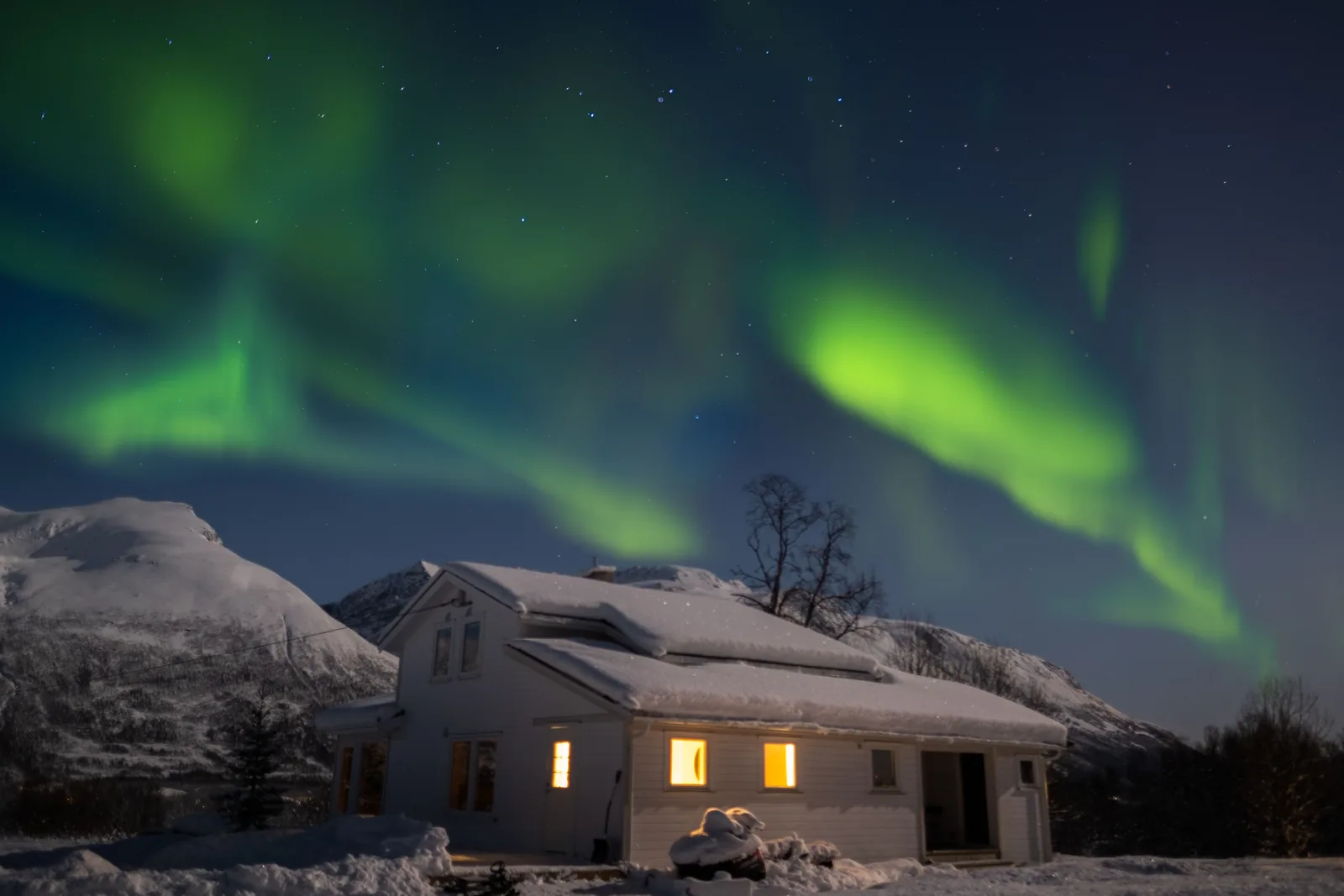
“A faint grey arc over the mountains that suddenly turns green, sharpens, and starts rippling across the whole sky above your head.”
There’s a moment every aurora hunter remembers. You’ve been standing in the snow for an hour, cold, staring at a sky that looks empty — and then a pale band appears over the horizon. It brightens. It turns green. And suddenly it’s moving: folding, pulsing and racing overhead in curtains that seem almost close enough to touch.
It belongs on the list because it’s one of the very few natural wonders you can’t visit on a schedule. The lights come from charged particles from the sun meeting the upper atmosphere, and no two nights are the same. Some displays are a soft glow; others fill the entire sky with ribbons of green, edged with pink and violet. Seeing them feels less like sightseeing and more like luck — and that’s exactly why it hits so hard.
And the Arctic winter around it is magical on its own: snow-covered forests, frozen fjords, husky teams, reindeer and long blue twilights. Even on a cloudy night, you’re somewhere few people ever see. On a clear one, you’ll understand why people cross the world to stand in the cold and look up.
From someday to a real plan
- Days needed
- 4–6 nights
- Best months
- Sep – Mar
- Budget
- US$180–450 per person per day
- Getting there
- Straightforward
- Crowds
- Moderate
Cloud is the main enemy, not a lack of aurora. Four or more nights in the Arctic gives you several chances at a clear sky.
You need real darkness. From about late April to mid-August the Arctic nights are too bright to see the lights.
Arctic Norway is expensive; Finnish Lapland and northern Sweden can be slightly cheaper. Guided aurora chases commonly cost about US$100–250 per person. Orientation ranges — verify before booking.
Frequent flights to Tromsø via Oslo, to Rovaniemi via Helsinki, and to Kiruna (for Abisko) via Stockholm. Getting there is easy; clear skies are the hard part.
Popular towns are busy in winter, but once you drive out of the city lights, most viewing spots feel wide open.
The year at a glance
- Jan
- Feb
- Mar
- Apr
- May
- Jun
- Jul
- Aug
- Sep
- Oct
- Nov
- Dec
Sep–Oct combine dark nights with milder weather and unfrozen lakes that reflect the lights. Jan–Mar bring deep snow and often clearer, colder skies. In Tromsø, the polar night (roughly late November to mid-January) gives long darkness but the most unsettled weather.
What you'll remember
- 01
The aurora overhead
Strong displays can fill the sky and move fast. When the lights appear directly above you in rays, it's called a corona.
- 02
Chasing the clear sky
Guides use cloud forecasts to drive inland, sometimes for hours, to find a gap. It's often the difference between seeing nothing and seeing everything.
- 03
Husky sledding
Being pulled across a frozen landscape by an excited dog team — as memorable as the lights for many people.
- 04
Reindeer and Sámi culture
Visits with Sámi reindeer herders introduce the Indigenous people of the Arctic. Choose experiences run or approved by Sámi communities.
- 05
Arctic fjords by day
Around Tromsø, winter fjord trips can bring whales in some seasons, pink low light and snowy peaks.
How the trip fits together
- 3–4 nights
Tromsø, Norway
The biggest Arctic base: flights, tours and fjords. Coastal weather means chases often head inland.
- 2–3 nights
Abisko, Sweden (alternative)
A small mountain village known for often-drier skies, with a scenic rail line from Narvik and Kiruna.
- 3–4 nights
Rovaniemi, Finland (alternative)
On the Arctic Circle in Finnish Lapland: forests, frozen lakes, huskies and glass-roof cabins.
Put it on your list if…
- Seeing the aurora is a dream you're willing to plan a winter trip around.
- You can enjoy snow, darkness and cold even on nights without lights.
- You're flexible enough to stay out late and change plans with the forecast.
Maybe skip it if…
- You need a guaranteed result: nobody can promise clear skies or a strong display.
- You only have 1–2 nights in the Arctic.
- Real cold (often -10 °C to -30 °C inland in midwinter) sounds miserable rather than exciting.
- Aurora forecasts are only reliable a few days ahead. Use official meteorological services for cloud forecasts and keep evenings flexible.
- Winter driving on ice and in darkness is demanding. If you're not experienced, book guided chases instead of self-driving.
- Pack serious cold-weather layers, or check which clothing your tour operator provides.
- Read tour policies carefully — 'guarantees' usually mean a free second tour, not a guaranteed display.